Karin Holt
"This work is not about fixing. It's about returning — to yourself, to steadiness, to what you can learn to trust again."
That's not an accident. It's the result of a particular combination of training, experience, and conviction about what healing actually requires.
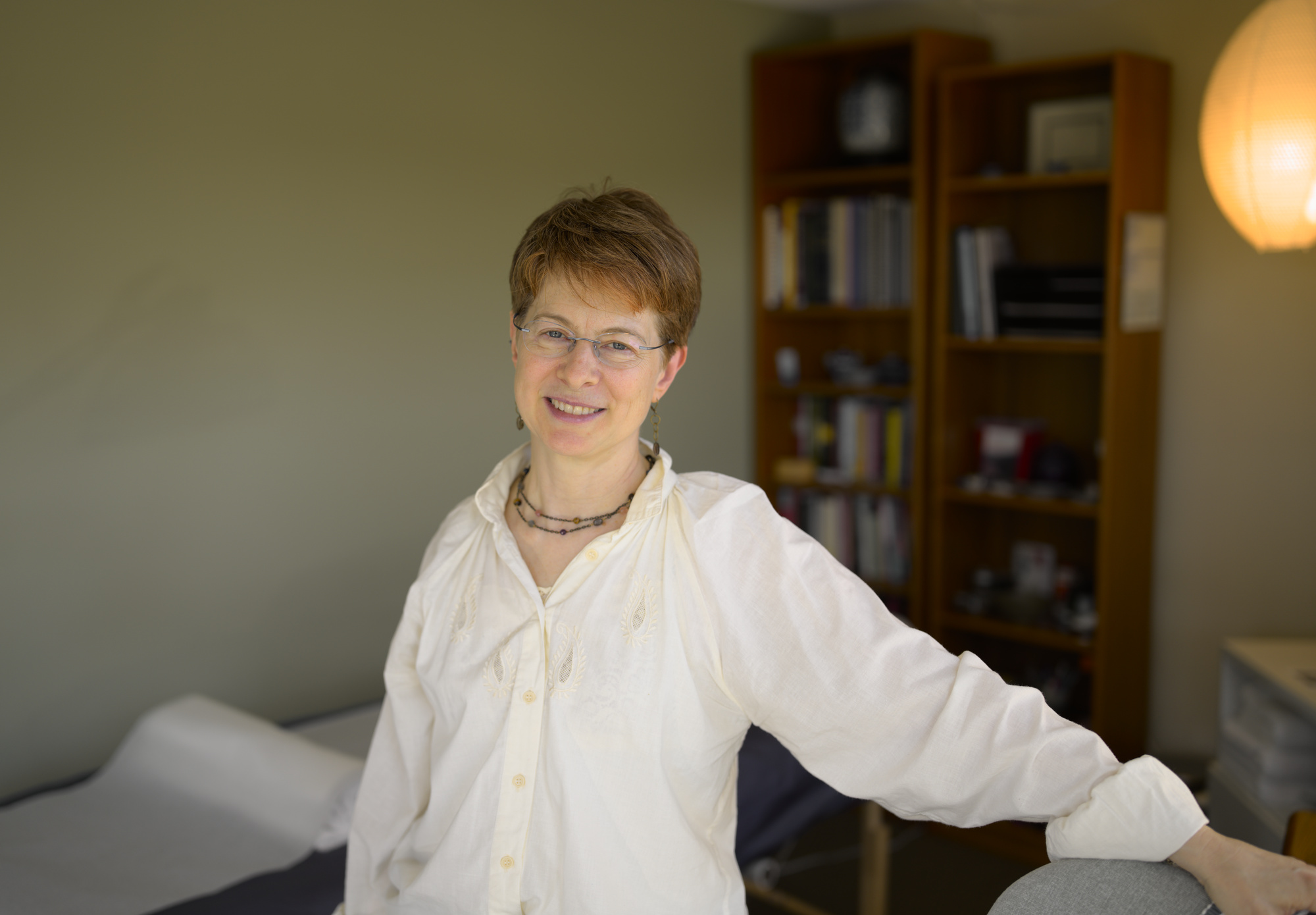
A clinical foundation in what bodies go through
I trained as a nurse at the Johns Hopkins School of Nursing and worked as an oncology nurse at Johns Hopkins Hospital — with patients going through chemotherapy, radiation, and stem cell transplants. That work gave me a close, unglamorous, deeply human education in what illness does to a body, and what people need when they are in the middle of something hard.
When I trained in acupuncture, I brought that clinical foundation with me. I didn't leave Western medicine behind — I learned to practice at the place where it meets something older and, in some ways, more complete.
Training rooted in a classical tradition
I trained in acupuncture at Tai Sophia Institute, within a program that took its foundation seriously. I had the privilege of training with the school's founders — an experience that shaped not just what I learned, but how I was taught to think about this medicine. A significant portion of that training took place through SOPHIA — the School of Philosophy and Healing in Action — where students were taught to be genuinely present with a patient before they were permitted to hold a single needle. The relational dimension of this work was not an afterthought. It was the beginning.
We learned to be genuinely present with a patient before we were permitted to treat one.
My training also connects me to a classical lineage — and that study is ongoing. I continue to work with Ann Cecil-Sterman through her Classical Medicine Academy and in-depth seminars. Ann practices in the tradition taught by Jeffrey Yuen, the 88th generation lineage holder of the White Jade Tradition of Classical Chinese Medicine — a lineage that includes Sun Si Miao, one of the most celebrated physicians in the history of the medicine. For fellow practitioners, these names will speak for themselves. For patients, what this means in practice is that the medicine I bring to each session is not static. It is alive, and I am still deepening it.
What happens before the needles
One of the things that distinguishes this practice — and that my patients often remark on — is what happens before any needles are placed. Before we begin treatment, I spend time, often ten to fifteen minutes, simply asking what's on your heart and mind. This is not intake paperwork in conversation form. It is the actual beginning of the work.
This approach was built into my training from the start. The premise at Tai Sophia was that you cannot choose the right treatment if you do not understand the person in front of you — not just their symptoms, but what they are carrying, what they are afraid of, and what they are hoping for.
I am currently deepening this capacity through training in hospital chaplaincy at Harborview Medical Center, a level one trauma center. Chaplaincy has taught me something that runs counter to most clinical training: that witnessing another person's experience — without moving immediately to correct or repair it — is itself a profound form of care. Much of medicine begins from the assumption that something is broken and needs to be fixed. That framing has its place. But it can also leave a person feeling like a problem to be solved rather than a human being to be accompanied.
I am not a psychologist, and I don't practice as one. But I have trained seriously in the art of listening — in a way that honors the wholeness of what you bring into the room. Then the needles continue that work, nonverbally, at a level words cannot always reach.
Where I come from
I was born in West Africa and came to the United States as a young person. Moving between two very different worlds at a formative age gave me something I've carried into my practice: the ability to see through more than one lens at a time. That capacity is part of why holding both Western medicine and Classical Chinese Medicine feels natural to me — not as a compromise between two systems, but as a richer way of seeing.
What I'm here to offer
I work with people who are carrying something complex — chronic illness, post-treatment recovery, a body that hasn't found its footing again. People who have been through a great deal and are looking for care that meets them at that level.
My job is not to tell you what you should feel, or to minimize what's hard, or to move through the appointment efficiently. My job is to pay attention — to all of you — and to use everything I know in service of your return to wholeness.
That word — wholeness — is one I use deliberately. It is what I have sought in my own life. It is what I believe is possible for the people I work with. And it is what I show up, every session, to help you find.
If any of this sounds like what you've been looking for, I'd love to hear from you.
Book Now